
How to Hire Employees in Malaysia: A Business Owner’s Step-by-Step Playbook for Fast, Compliant Onboarding


How to Hire Employees in Malaysia: A Business Owner’s Step-by-Step Playbook for Fast, Compliant Onboarding

Key Takeaways
- Hiring in Malaysia demands strict adherence to the Employment Act 1955, EPF, SOCSO, and EIS — non-compliance can trigger audits, fines, and reputational damage.
- Setting up a legal entity takes months and thousands of dollars, while an Employer of Record (Malaysia EOR) can bring an employee on board in as little as 48 hours.
- Transparent, fixed-fee Malaysia employer of record services like MalaysiaHire EOR start at $165 per employee per month, covering contracts, payroll, and statutory filings.
- Statutory contribution rates for EPF (up to 12% employer share), SOCSO, and EIS must be budgeted accurately to avoid payroll surprises.
- Speed is a competitive lever; the quicker you hire, the faster you can seize market opportunities in Kuala Lumpur’s fast-moving economy.
- Common mistakes include misclassifying workers as independent contractors and skipping mandatory probation periods — both can lead to costly legal disputes.
- A dedicated EOR partner provides not just payroll but local HR guidance, Employment Pass processing, and an on‑the‑ground office presence.
- You can test the market without a local entity, using an EOR to employ your first team members while you evaluate long‑term expansion in Malaysia.

The Untapped Opportunity in Malaysia — and the Hiring Headache That Comes With It
Malaysia’s economy is quietly becoming one of Southeast Asia’s most attractive destinations for global business expansion. With a pro‑business government, a young, English‑proficient talent pool, and a strategic location, it is no wonder companies are looking to hire employees in Malaysia right now. The country’s digital economy alone is projected to contribute over 25% of GDP by 2025, and Kuala Lumpur consistently ranks as a top hub for shared services and regional headquarters.
But here’s the catch: employing someone in Malaysia is not as simple as signing a contract and wiring a salary. The regulatory landscape is layered with mandatory contributions, tightly‑written labour laws, and a real cultural expectation for structured employment. A single misstep — such as incorrectly classifying a full‑time worker as a contractor — can trigger penalties, back taxes, and a lost reputation with local authorities.
Many business owners I speak with feel caught between speed and compliance. You want to move fast to capture market share, but you also know that cutting corners on employment can blow up later. That tension is exactly why a strategic approach to hiring — often powered by a Malaysia employer of record (EOR) — has become the go‑to playbook for savvy founders and operations leads. Over the next few sections, I’ll walk you through exactly how to build a compliant, cost‑effective Malaysian team without the usual headaches.
Understanding Malaysia’s Employment Framework: The Non‑Negotiables
Before you even think about posting a job ad, you need a firm grasp on the legal skeleton that holds the employment relationship together. Unlike some markets where labour laws are relatively relaxed, Malaysia’s framework is specific and enforcement is active. The three pillars you’ll deal with on day one are the Employment Act 1955, the Employees Provident Fund (EPF), and the Social Security Organisation (SOCSO), along with the Employment Insurance System (EIS).
Ignorance is not an excuse here. For example, if you fail to register an employee with SOCSO within 30 days, you face a fine of up to RM10,000. Even seemingly minor details — like what you include in the offer letter under the Employment Act — can later become the basis for a formal complaint. The easiest way to stay safe is to partner with a Malaysia EOR that already has these mechanisms baked in, but as a business owner you should understand the fundamentals. Let’s break each one down.
The Employment Act 1955: Who It Covers and What It Mandates
The Employment Act is the cornerstone law for private‑sector employees in Peninsular Malaysia and Labuan (Sabah and Sarawak have their own ordinances, but the principles are similar). Originally drafted to protect blue‑collar workers, its coverage has expanded significantly. As of 2023, all employees regardless of wages are covered under the Act, meaning even your well‑paid regional head is entitled to sick leave, annual leave, public holiday pay, and overtime protections unless they fall under a narrow set of exempt roles.
For a business owner, the practical implications are immediate. Written employment contracts are mandatory and must spell out terms like wages, notice periods, working hours, and termination conditions. The Act also prescribes minimum notice periods (as short as four weeks for employees with less than two years of service) and outlines strict rules around termination for misconduct. When you hire employees in Malaysia, you’re entering a relationship that the government actively safeguards — and that’s a good thing, as long as you know the rules.
Statutory Contributions: EPF, SOCSO, and EIS in Real Numbers
This is where many first‑time employers get tripped up. Malaysian statutory contributions are not optional add‑ons; they are mandatory monthly liabilities that must be calculated, deducted, and remitted on time. Here’s a quick breakdown: • EPF (Employees Provident Fund): Employees contribute 11% of their salary; employers contribute 12% (or 13% for salaries below RM5,000, depending on the scheme). The employer’s share is a direct cost on top of gross salary. • SOCSO (Social Security Organisation): Covers workplace injury and invalidity. Employer contribution rates range from 0.5% to 3.25% of an employee’s salary, depending on the wage bracket. Employee contributions are minimal (0.5% capped at RM19.75 per month). • EIS (Employment Insurance System): Both employer and employee contribute 0.2% of salary each, with a cap. This funds unemployment benefits.
If you budget only for the base salary, you’re under‑budgeting by at least 13–16%. A Malaysia employer of record platform automatically computes and files these payments, so you never miss a deadline.
Employment Pass for Foreign Talent: A Word of Caution
The Employment Act covers local and foreign employees alike, but if you plan to hire expatriates, you’ll need an Employment Pass. The pass is tied to a specific employer and requires justification (e.g., a minimum salary of RM5,000 for most sectors, though higher for some). Processing can take 6–8 weeks when done directly. Our earlier guide covers visa steps in detail; what I want to emphasize here is that a specialist EOR can file the application on your behalf, using its own entity as the sponsor. This turns a bureaucratic obstacle into a background process, so your new hire can start with the right paperwork from the get‑go.
Hiring Options: Direct Entity vs. Employer of Record — A Strategic Comparison
Once you understand the legal requirements, the next question is: how will you actually employ someone? You essentially have two routes. The first is the traditional path — incorporate a local subsidiary (Sdn. Bhd.), register with all relevant authorities, open a local bank account, and build an internal HR and payroll function. The second is to engage a Malaysia EOR, which already has that infrastructure and employs the worker on your behalf while you direct their daily work.
I’ve seen both approaches work, but the decision hinges on three factors: speed, budget, and strategic commitment. If you’re testing the waters or need a team in place within weeks, an EOR wins hands down. If you’re planning a long‑term manufacturing plant with hundreds of workers and tangible assets, incorporation may make sense — but expect a 2‑ to 4‑month setup timeline and at least RM50,000 in initial capital and legal costs. Let’s compare.
The Traditional Route: Incorporating a Local Entity
Setting up a Malaysian private limited company means registering a unique name, appointing at least one resident director, finding a registered office address, and obtaining numerous licenses — from a Certificate of Incorporation to EPF, SOCSO, and tax files. The process demands patience and local connections. You’ll also need to open a business bank account, which itself can take several weeks if signatories are overseas. Only then can you begin the process to hire employees in Malaysia under your own banner. For a lean startup or a company eager to seize a time‑sensitive project, these months are often the difference between capturing an opportunity and watching a competitor walk in first.
The Agile Route: Partnering with a Malaysia Employer of Record
An EOR flips the script. The provider already has the entity, the bank accounts, the payroll engine, and the track record with government bodies. You simply identify the person you want to hire, agree on the salary and start date, and let the EOR handle the entire employment lifecycle — contracts, statutory registration, monthly payroll, tax filing, and even equipment allocation if needed. Because the EOR acts as the legal employer, you bypass entity setup entirely. Employees get a locally compliant contract, full statutory benefits, and a genuine employer of record that understands Malaysian labour law, all while you focus on scaling your business.
Side‑by‑Side Comparison at a Glance
- Time to hire: Direct entity 2–4 months (establishment + hiring) vs. EOR 2–14 days (onboarding only).
- Upfront cost: RM50,000+ for entity registration and compliance vs. zero setup fee with most EORs.
- Monthly cost: Ongoing internal HR, office, and compliance overhead vs. a fixed per‑employee fee (starting at $165/month with MalaysiaHire EOR).
- Control level: Full operational control with direct management; EOR gives you complete day‑to‑day direction while the provider handles legal employment.
- Risk exposure: Directly liable for all employment mistakes vs. shared or transferred compliance risk under an EOR model.
- Scalability: Need internal team growth; EOR can add or remove employees in days without restructuring.
The 48‑Hour Hiring Sprint: How a Modern Malaysia EOR Onboards Employees
If there’s one pain point that business owners complain about most when expanding in Asia, it’s the lethargic pace of bureaucracy. This is where the notion of a “fast EOR” becomes transformative. I’ve witnessed savvy operators go from a signed offer letter to a fully compliant, EPF‑registered employee in under two days — no sales calls, no back‑and‑forth with multiple agencies, no waiting for a bank account. That’s the model MalaysiaHire EOR runs on: a 48‑hour onboarding promise backed by a fully digital, documentation‑first platform.
How does it work in practice? The secret is that the EOR has already completed all the heavy lifting. The legal entity exists, the payroll templates are pre‑configured with EPF, SOCSO, and EIS formulas, and the employment contract library is vetted by local counsel. Your job is to provide the candidate’s details and the agreed salary. The platform takes it from there. Let’s walk through the sprint stage by stage.
Step 1: Define the Role and Select Your Candidate
The process begins before the EOR even gets involved. You decide on the role, the skill set, and the budget. You can use your own recruiters, LinkedIn, or local job portals to find the right person. Once you extend an informal offer and the candidate accepts, you simply instruct your EOR partner to generate the formal employment documentation. There is no need for the EOR to “approve” your candidate beyond basic eligibility checks — you retain full hiring authority.
Step 2: Provide Candidate Documents and Approve the Contract
You send the candidate’s NRIC (identity card) copy, educational certificates, and any other required information through the EOR’s secure portal. Within hours, the platform generates a fully localised employment contract aligned with the Employment Act, detailing probation periods, working hours, leave entitlement, and statutory contributions. As the client, you review and approve — often with a single click. The candidate then e‑signs electronically. There is no printing, scanning, or physical courier involved.
Step 3: The EOR Registers the Employee with All Authorities
This is the step that traditionally takes weeks. The Malaysia EOR submits the employee’s details to EPF, SOCSO, EIS, and the Inland Revenue Board (LHDN) for tax file creation. Because the EOR has an active employer registration already, the process is administrative, not exploratory. A top‑tier provider like MalaysiaHire EOR also allocates a local office address for the employee’s employment pass application, if needed, and initiates the application on the same day. Payroll is configured simultaneously, mapping the salary to statutory deduction tables.
Step 4: Employee Begins Work, Fully Compliant from Day One
By the morning of the start date, the employee has a signed employment contract, an EPF number, SOCSO registration, and a confirmed payroll schedule. They can walk into a co‑working space or work remotely with full confidence that their employment is protected under Malaysian law. For you, the business owner, the only monthly task is to review and fund the payroll invoice, which includes salary, employer contributions, and the EOR fee. That’s it. You’ve successfully hired an employee in Malaysia in less time than it takes some companies to open a bank account.
The True Cost of Hiring an Employee in Malaysia: A Transparent Breakdown
Let’s talk numbers, because this is where a lot of global expansion pitches get fuzzy. I’m a big believer that cost clarity builds trust. When you hire employees in Malaysia, your total cost has four buckets: gross salary, employer statutory contributions, the EOR service fee (if you use one), and any ancillary benefits you choose to offer, such as medical insurance or a transport allowance. The combined total is what you should benchmark against your home‑market cost of employment.
A frequent trap is comparing only the headline salary. A regional sales manager earning RM10,000 per month will actually cost you closer to RM11,200‑11,500 after EPF (12%), SOCSO (approximately 1.75% for that bracket), and EIS (0.2%). If you fail to budget for these, your project’s P&L will start bleeding. Then layer on the EOR fee. A fixed‑price Malaysia employer of record like MalaysiaHire EOR charges a flat $165 per employee per month, no percentage of salary, no hidden setup fees. That predictability allows you to forecast with confidence.
Cost Components at a Glance
- Gross monthly salary: The amount you negotiate with the employee — your baseline.
- Employer EPF contribution: 12% of salary (or 13% for lower‑wage workers), added on top.
- Employer SOCSO contribution: Sliding scale from 0.5% to 3.25% based on salary band.
- Employer EIS contribution: 0.2% of salary, capped.
- EOR monthly fee: Typically a fixed amount, such as $165/month with MalaysiaHire EOR.
- One‑off costs: Some EORs charge a setup fee; transparent providers have none.
- Optional benefits: Medical insurance, dental, travel allowance, etc., which you can tailor to remain competitive.
EOR Pricing vs. Hidden Entity Costs
Many founders underestimate the true cost of running a local entity. Beyond the initial capital and registration fees, you’ll need to budget for a registered office (even a virtual one), annual filings, audit fees, a local director (if you don’t have one), and at least a part‑time HR or accountant to handle payroll and compliance. All in, these can easily exceed RM2,000–RM3,000 per month before you even hire your first employee. An EOR rolls all that infrastructure into a single per‑employee fee, making it not just faster but often cheaper for teams under 20.
Common Mistakes That Cost You Time and Money — and How to Sidestep Them
I’ve witnessed the same blunders repeatedly — some from DIY‑keen entrepreneurs, others from companies that relied on generic global expansion advice without local nuance. The good news is that once you know them, they’re almost entirely avoidable. Here are the pitfalls I urge every business owner to keep on their radar when they set out to hire employees in Malaysia.
- Misclassifying employees as independent contractors to save on EPF and SOCSO. The Malaysian courts and courts of law use a “substance over form” test — if you control their schedule, provide tools, and they work exclusively for you, they’re an employee. Getting this wrong triggers massive backdated contributions and penalties.
- Failing to include a proper probation period in the employment contract. The Employment Act allows probation for up to three months, which is the standard in Malaysia. Without it, you lose the ability to assess fit and terminate more easily during the early stage.
- Neglecting to register the employee within 30 days of start. Late registration with EPF and SOCSO attracts fines and puts the employee’s coverage at risk, eroding trust from day one.
- Assuming a global EOR automatically understands Malaysian public holidays and culturally expected bonuses. Malaysia has 14+ gazetted public holidays per state, and a contractual bonus (at least one month) is so common it’s practically expected for many roles. A generic platform may miss these nuances.
- Using a handshake agreement or a foreign‑law contract. Under Malaysian law, employees must be covered by a contract governed by Malaysian employment legislation. A contract drafted under Singaporean or US law won’t hold up before the Industrial Court.
- Rushing into a long‑term office lease before understanding your actual headcount. An EOR allows you to hire first and find a workspace later, avoiding the sunk cost of an empty office or a lease that’s too big or too small.
Why Local Expertise Matters More Than a Global Brand Name
It’s tempting to default to a well‑known global EOR because the logo feels familiar. But here’s what I’ve learned: employment is deeply local. The EPF officer who audits your account, the SOCSO inspector who visits your worksite, the Labour Department officer who mediates a dispute — they all operate within a Malaysian context shaped by cultural expectations, language, and unwritten norms. A provider that has a dedicated office in Kuala Lumpur and a career‑long understanding of Malaysian HR isn’t a nice‑to‑have; it’s the difference between a smoothly resolved issue and a multi‑month administrative nightmare.
Consider something as simple as a workplace inspection. If a local authority shows up at the company’s registered address, they expect to find a physical office and a person who speaks Bahasa Melayu to handle the conversation. A global EOR that routes everything to a call centre in another timezone leaves you exposed. MalaysiaHire EOR, by contrast, maintains an on‑the‑ground presence in KL specifically for these real‑world moments. When you hire employees in Malaysia, you’re not just hiring talent; you’re entering the country’s social compact, and local expertise is your best guarantee of staying in good standing.
Is a Malaysia Employer of Record Right for Your Business? A Decision Framework
Not every business needs an EOR, but many more qualify than realise it. I like to break the decision down into a handful of straightforward tests. If you answer “yes” to most of the following, a Malaysia employer of record is likely your smartest first step.
- You need to hire your first Malaysian employee within the next 30 days.
- You don’t currently have a registered legal entity in Malaysia.
- You want to avoid the capital outlay and administrative burden of company incorporation right now.
- Your immediate team size is under 20 people, and you value flexibility to scale up or down quickly.
- You plan to hire a mix of local and foreign talent and need a streamlined Employment Pass process.
- You want fixed, predictable employment costs with no surprise compliance fees.
- Your management team can direct daily work remotely, and you don’t require a wholly owned physical office from day one.
- You value a partner with a local office, a Malaysian bank account, and the ability to handle face‑to‑face government interactions.
Your Next Move: From Intention to a Hired Team
By now, you should have a clear picture of what it actually takes to hire employees in Malaysia — not the glossy brochure version, but the real, boots‑on‑the‑ground reality. The legal framework is robust, the cost structure is transparent once you account for statutory contributions, and the speed of execution has changed dramatically thanks to specialised Malaysia EOR services.
If there’s one idea I want you to take away, it’s this: you can have a Malaysian employee legally working for you within a week, without a company, without a bank account, and without an in‑house lawyer. The 48‑hour sprint model that providers like MalaysiaHire EOR have pioneered turns what used to be a months‑long project into a simple hire‑and‑go workflow. The first step is as simple as identifying the role and the person. From there, the right EOR partner can take the wheel, leaving you free to focus on growing revenue, not deciphering EPF contribution tables.
So, whether you’re a funded startup eyeing KL for an engineering hub or a regional business that needs a small sales team in Selangor, the playbook is ready. The market opportunity is here, the talent is hungry, and the compliance path is clearer than it has ever been. All that’s left is to make the hire.
Frequently Asked Questions
How long does it take to hire an employee in Malaysia through an EOR?
A modern Malaysia Employer of Record can onboard an employee in as little as 48 hours. This includes contract generation, work permit verification if needed, payroll setup, and statutory registration. This speed contrasts sharply with the months typically required for setting up a local entity and obtaining compliance approvals.
What are the mandatory employee benefits I must provide in Malaysia?
Employers in Malaysia must provide contributions to the Employees Provident Fund (EPF), the Social Security Organization (SOCSO), and the Employment Insurance System (EIS). Additionally, a minimum of 8 paid public holidays, annual leave of 8 days for employees with under two years of service, and statutory sick leave are compulsory under the Employment Act 1955.
Can I terminate an employee under probation in Malaysia easily?
While probationary employees have less stringent protections under Malaysian law, termination must still be based on just cause or poor performance with documented evidence. A simple notice period, typically one to two months, applies. Without proper documentation of underperformance, the company risks an unfair dismissal claim at the Industrial Court.
What is the difference between a fixed-term contract and permanent employment in Malaysia?
A fixed-term contract in Malaysia has a specific end date and is used for temporary projects or seasonal work. Permanent employment offers ongoing tenure. Crucially, a fixed-term contract of three months or more automatically converts to permanent if the employee continues working after the contract ends without a new written agreement. This protects workers from indefinite temporary status.
How does the Malaysian minimum wage affect my hiring budget for foreign workers?
The Malaysian minimum wage applies equally to all employees, including foreign workers, and is currently RM 1,500 per month. This base rate directly impacts the total payroll cost for foreign staff, as you must pay at least this amount before adding mandatory EPF, SOCSO, and EIS contributions. Budget accordingly to avoid underpayment and legal penalties.
What are the legal risks of misclassifying a contractor as an employee in Malaysia?
Misclassifying a contractor as an employee in Malaysia can lead to substantial back payments for unpaid EPF, SOCSO, and EIS contributions, plus penalties from the authorities. The worker may also claim entitlements like annual leave and overtime. The test for employment focuses on control, integration, and economic reality, not just the contract label.
How do I verify that a Malaysian Employer of Record is compliant with local laws?
To verify a Malaysia EOR’s compliance, request proof of their local license and registration with the Ministry of Human Resources. Check for a physical office and local legal counsel. Confirm they have a registered entity under the Companies Act 2016. A compliant EOR will transparently share their statutory registration numbers and audit records.
What is the typical notice period for resigning employees in Malaysia?
The typical notice period for resigning employees in Malaysia is four weeks for those with less than two years of service. This increases to eight weeks for employees with two to five years of service, and to twelve weeks for those with over five years. These periods are set by the Employment Act 1955 and can be modified by contract as long as they are not shorter than statutory minima.
MalayHire is your most cost-effective Employer of Record (EOR) in Malaysia
Hire full-time employees in Malaysia and save costs by avoiding hefty contractor fees. MalayHire handles payroll, employment contracts, statutory compliance (EPF, SOCSO, EIS), and HR admin. Start onboarding your Malaysian hire now, with MalayHire.
Trusted by global companies hiring in Malaysia





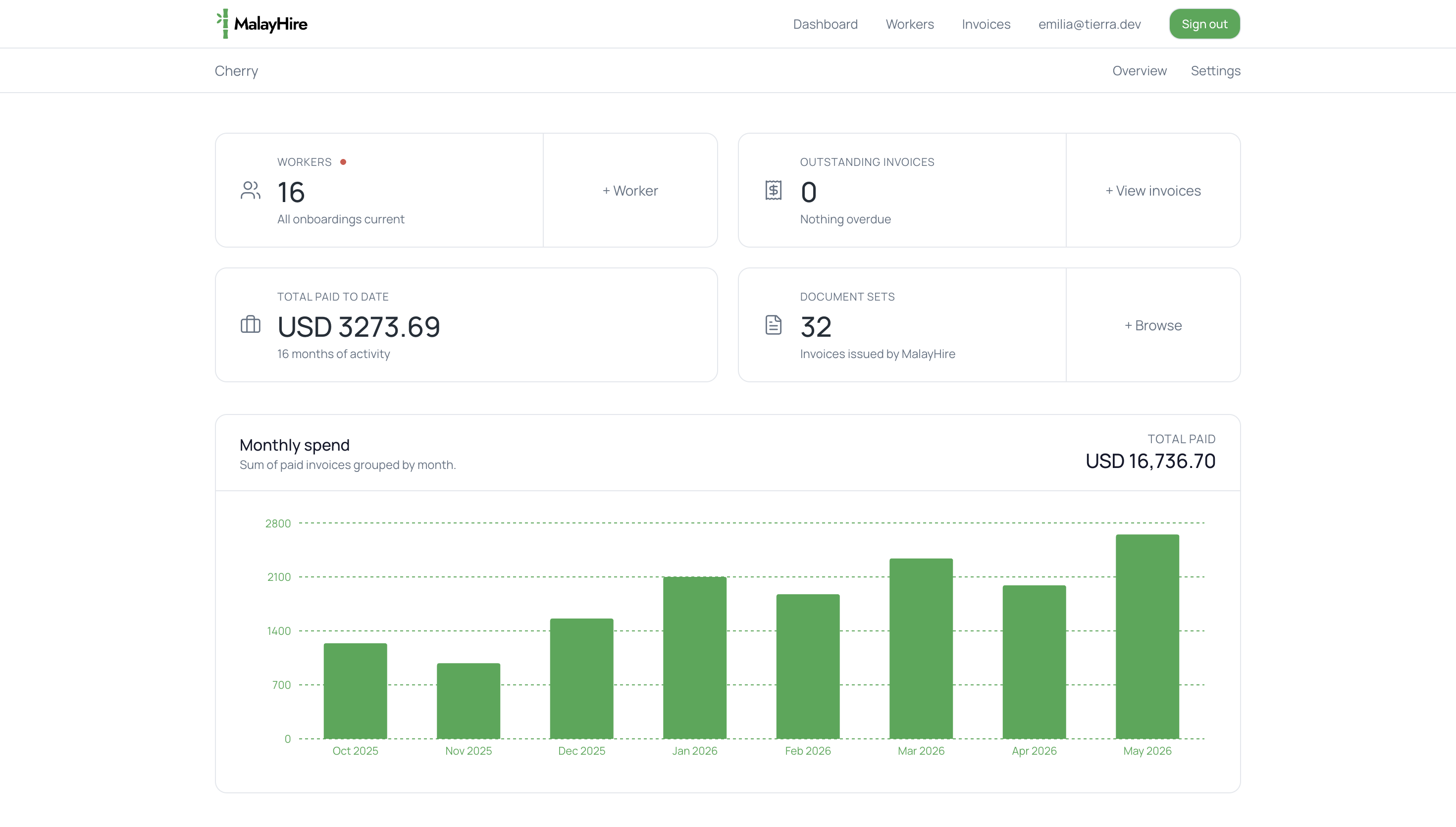
Manage your Malaysian team, payroll & EOR compliance in one place.