
Malaysia Employee Taxes: The Business Owner’s Guide to EPF, SOCSO, PCB, and More


Malaysia Employee Taxes: The Business Owner’s Guide to EPF, SOCSO, PCB, and More

Key Takeaways
- Malaysia employee taxes are a mix of compulsory contributions (EPF, SOCSO, EIS) and monthly income tax deductions (PCB) that every employer must calculate and remit on time.
- The four pillars are EPF (retirement savings), SOCSO (work-related injury and invalidity coverage), EIS (employment loss protection), and PCB (progressive income tax withholding).
- Employers bear the bulk of EPF and SOCSO contributions, and non-compliance can trigger penalties of up to 10% per annum plus legal action.
- Contribution rates vary by employee type and wage bracket — for example, a Malaysian citizen earning RM5,000 triggers around 13% employer EPF plus 0.5% employee SOCSO and 0.2% EIS.
- Monthly deadlines fall on the 15th of the following month for all statutory payments, making a rigid payroll calendar essential to avoid late payment charges.
- Annual reporting obligations (Form E and EA) add another layer that many business owners overlook until it’s too late.
- Leveraging a local Employer of Record can eliminate manual calculation risks and ensure full compliance from day one, especially for companies without an on-ground HR team.
- Getting employee taxes right isn’t just about avoiding fines — it’s the foundation of a trustworthy employer brand in Malaysia.
Why Understanding Employee Taxes Matters for Your Business
When you hire your first team member in Kuala Lumpur or Penang, the excitement of scaling can quickly collide with the reality of statutory deductions. Malaysia employee taxes aren’t a simple flat rate you can memorize in five minutes. They’re a layered system designed to fund retirement, social security, employment insurance, and national tax receipts — all collected through your payroll. If you treat them as an afterthought, you’ll end up facing penalty notices, disgruntled staff, and a reputation hit that’s hard to shake.
Think of employee taxes as the plumbing inside your company’s payroll. When the pipes work, nobody notices. The moment they leak, everything else — morale, compliance, cash flow — gets soaked. As a business owner, you’re both the plumber and the building inspector. You need to understand what each deduction does, how much to withhold, when to pay it, and what happens if you don’t.
This guide goes deep into the mechanics of employee taxes in Malaysia, from contribution tables to filing rhythms. Whether you’re running a five-person startup or planning a 50-person regional hub, you’ll walk away with a practical framework that turns tax compliance from a headache into a routine.
The Core Components of Malaysia Employee Taxes
Malaysia’s statutory employee deductions rest on four pillars: the Employees Provident Fund (EPF), the Social Security Organization (SOCSO), the Employment Insurance System (EIS), and the Monthly Tax Deduction (PCB, sometimes called MTD). Each serves a distinct purpose, and missing any one of them is a red flag for regulators. Below I’ll unpack each pillar so you can see exactly where your money goes and why it matters.
Employee Provident Fund (EPF)
Think of EPF as Malaysia’s national retirement piggy bank — but one where you as the employer contribute more than your employee does. For Malaysian citizens and permanent residents under 60, the standard employee contribution is 11% of monthly wages, while the employer chips in 12% for staff earning above RM5,000 and 13% for those at RM5,000 and below. These rates apply to wages including overtime, commissions, and allowances, not just base salary. Foreign workers contribute just RM5 or 11%, depending on the visa category, with a flat employer contribution of RM5 per month.
The twist many business owners miss is the statutory wage ceiling. EPF requires contributions on wages up to RM20,000 per month. Anything earned above that is exempt, which can significantly change your payroll math if you’re hiring senior talent. Contributions must be paid by the 15th of the following month, and late payments incur a daily interest charge of 10% per annum, so precision in your payroll schedule is everything.
Social Security Organization (SOCSO)
SOCSO covers two schemes: the Employment Injury Scheme and the Invalidity Scheme. Here’s where it gets easy to confuse employer vs. employee burden. The Employment Injury Scheme is fully employer-funded, costing roughly 1.75% of wages, while the Invalidity Scheme splits 0.5% from the employee and 0.5% from the employer. In practice, when you process payroll, you’ll deduct 0.5% from your employee’s salary for SOCSO and add your own larger share before remitting the total.
There’s a monthly wage ceiling of RM4,000 for contribution calculations — so if someone earns RM5,000, SOCSO contributions are still based on RM4,000. That cap changes periodically, so it’s smart to check the latest schedules from PERKESO each year. SOCSO payments also follow the 15th-of-the-following-month deadline, and a delay triggers an 8% per annum late contribution interest charge.
Employment Insurance System (EIS)
EIS is the youngest of the four pillars, introduced in 2018 to provide a safety net for workers who lose their jobs. The beauty — and simplicity — is the tiny cost: both employer and employee pay just 0.2% each of the employee’s monthly wages. For a staff member earning RM5,000, that’s RM10 from each side.
The wage ceiling mirrors SOCSO at RM4,000, so the maximum EIS payment is only RM8 from the employee and RM8 from the employer per month. Despite the low amounts, don’t skip it. LHDN and SOCSO cross-check EIS contributions against your other filings, and discrepancies can trigger audits that drain far more time than the contribution is worth.
Monthly Tax Deduction (PCB / MTD)
PCB, or Potongan Cukai Bulanan, is Malaysia’s pay-as-you-earn income tax withholding. Unlike EPF and SOCSO which are fixed percentages, PCB is calculated using progressive tax rates based on the employee’s estimated annual income after reliefs. A married employee with three kids and a home loan can end up with a very different PCB figure than a single colleague earning the same salary.
As the employer, you must register each employee with LHDN and use the official PCB calculator or tables to determine the exact monthly deduction. The key is updating the employee’s TP1 form whenever their circumstances change — otherwise you could under-deduct and trigger a large tax bill for them at year-end. PCB payments are due by the 15th of the following month, with a 10% penalty on unpaid amounts, rising to 15% after 60 days.
Crunching the Numbers: Actual Contribution Rates and Examples
It’s one thing to read about percentages; it’s another to see them applied to a real Malaysian salary. Let’s walk through a concrete scenario — a Malaysian citizen employee earning RM5,000 per month in 2025 — and break down each slice that leaves the payroll account. I’ll also highlight how the statutory caps work so you’re not over-contributing.
EPF Contribution Rates at a Glance
- Employee: 11% of monthly wages (no ceiling for employee side if wage ≤RM20,000, but effectively capped at the statutory ceiling of RM20,000).
- Employer for wages ≤RM5,000: 13%.
- Employer for wages >RM5,000: 12%.
- For a RM5,000 salary, this means: employee EPF = RM550, employer EPF = RM650 (since it’s ≤5,000).
- Foreign workers: Employee pays RM5 or 11% depending on visa status; employer pays RM5 flat.
SOCSO and EIS Contributions for the Same Employee
- SOCSO employee (Invalidity Scheme): 0.5% of monthly wage, capped at RM4,000 → 0.5% of RM4,000 = RM20.
- SOCSO employer (both schemes): about 1.75% + 0.5% = 2.25% of RM4,000 = RM90.
- EIS employee: 0.2% of RM4,000 = RM8.
- EIS employer: 0.2% of RM4,000 = RM8.
- Total employee statutory deductions (EPF, SOCSO, EIS, excluding PCB): RM550 + RM20 + RM8 = RM578.
- Total employer cost beyond gross salary: RM650 + RM90 + RM8 = RM748.
PCB (Income Tax) in Practice
Using the LHDN 2025 PCB calculator for a single resident employee with no additional reliefs, earning RM5,000 monthly and contributing RM578 in EPF/SOCSO/EIS, the estimated PCB would be around RM70–RM90 per month, depending on the exact reliefs claimed. That brings the net salary after all employee deductions to roughly RM4,332–RM4,352. The employer’s total cost to employ this person — gross salary plus employer EPF, SOCSO, and EIS — lands at RM5,748. That gap between net take-home and total employer cost is where many business owners underestimate the real price of hiring in Malaysia.
Employer Responsibilities That Go Beyond Deductions
Withholding the right amounts is just the start. Malaysian law expects you to register with each statutory body, submit monthly returns, and file annual reports. Missing any of these administrative steps can be just as costly as a calculation error.
Registration Requirements
Before you can even pay EPF or SOCSO, you must register both your company and each employee with KWAP (EPF board), PERKESO (SOCSO), and LHDN (PCB). This requires details like the employee’s IC number, salary start date, and tax reference. The process isn’t complex, but doing it manually for multiple hires can eat hours. If you’re using an EOR, this is handled before the employee’s first day.
Monthly Contributions and Forms
Each month, you’ll need to file Form A (EPF), Form 8A (SOCSO), SIP Form (EIS), and CP39 (PCB). These forms detail the contributions for every employee. Most employers now use e-Caruman, ASSIST, and e-PCB portals to submit and pay online. Still, a single typo in an employee’s name or wages can bounce the submission, so double-checking data before the 15th is a non-negotiable routine.
Annual Reporting — Form E and EA
By March 31 each year, you must submit Form E to LHDN, which summarizes all employee earnings and PCB remittances for the previous calendar year. You also need to issue Form EA to each employee, a statement of their total remuneration and deductions for their personal tax filing. Even if an employee resigns in February, they need an EA form. Business owners who dish out a single lump-sum form in April are asking for an LHDN query — or worse, a surprise audit.
Deadlines and Penalties That Can Derail Your Budget
Nothing sharpens attention like a penalty notice. Here’s a timeline that governs every payroll cycle, plus the financial consequences of missing it.
- EPF: Due by the 15th of the following month. Late payment attracts interest at 10% per annum calculated daily from the payment deadline, plus a late payment charge that can escalate the total penalty.
- SOCSO & EIS: Due by the 15th. Late contribution interest is 8% per annum, and repeated non-compliance can lead to court action with fines up to RM10,000 or imprisonment.
- PCB: Due by the 15th. A penalty of 10% is levied on the unpaid amount, and if unpaid for 60 days, the penalty rises to 15%. LHDN can also prosecute directors individually.
- Form E & EA: Due by March 31 for the preceding year. Late filing of Form E incurs a minimum fine of RM200, scaling up to RM20,000, and can trigger a desk audit.
- All payments must be made electronically; most banks cut off online transactions at 11:59pm, so scheduling them on the 14th is the safest play.
Common Pitfalls When Managing Employee Taxes Yourself
Even seasoned finance managers slip up. Over the years, I’ve seen the same mistakes surface again and again. Knowing them upfront can save you weeks of cleanup.
- Assuming all employees have the same contribution rates. A senior expat on an Employment Pass with a different EPF category, a part-timer, or a staff member over 60 all trigger different percentages.
- Using the old PCB table after a mid-year budget announcement. LHDN updates the MTD schedule occasionally, and applying stale rates leads to under- or over-deduction.
- Forgetting to update TP1 forms when an employee gets married, has a child, or buys a property. The PCB won’t reflect new tax reliefs and the employee gets a shock at year-end.
- Miscalculating the wage base for EPF and SOCSO caps. Including bonuses in a single month can push the total above RM20,000 (EPF) or RM4,000 (SOCSO); failing to cap the contribution correctly means paying more than required.
- Treating probationers as contractors. In Malaysia, if the relationship walks like employment and quacks like employment, the statutory bodies consider them employees from day one. Misclassifying them to avoid contributions is a huge risk.
How MalayHire EOR Simplifies Malaysia Employee Taxes
If you’re expanding into Malaysia without an existing legal entity, or you simply want to offload the administrative weight of tax compliance, an Employer of Record service like MalayHire EOR can be the missing link. Instead of you wrestling with four different portals and three deadline dates every month, the EOR becomes the legal employer for tax purposes, calculating, deducting, and filing everything on your behalf.
What sets MalayHire apart in the payroll, tax, and benefits space is speed and transparency. Onboarding a new hire takes 48 hours — no sales calls, no paper stacks. The platform auto-configures EPF, SOCSO, EIS, and PCB based on the employee’s type and salary, and all monthly submissions happen within a fixed monthly cost starting at $165 per employee. That means you never stare at a spreadsheet wondering if you missed a decimal. For business owners who need an immediate, compliant on-ground team in Kuala Lumpur while they focus on revenue, this transforms employee taxes from a compliance burden into a predictable line item.
The Strategic Advantage of Getting Employee Taxes Right
Landing on the right side of Malaysian employee taxes isn’t just about dodging penalties. It’s one of the strongest signals you can send to your local team. When an employee sees that their EPF and PCB are always accurate and on time, they feel financially safe. When a SOCSO claim for a workplace accident processes smoothly, you’ve built trust you can’t buy with a bonus.
From a business standpoint, clean payroll tax records make funding rounds, acquisitions, and talent attraction remarkably smoother. Investors and partners often run compliance checks before writing a cheque, and messy EPF arrears are a red flag. By treating employee taxes as a strategic function rather than an accounting chore, you position your Malaysian operations for sustainable growth. And if the nuts and bolts ever feel overwhelming, knowing that a local EOR can shoulder the load in 48 hours gives you an immediate off-ramp.
Frequently Asked Questions
What happens if I miss the EPF contribution deadline in Malaysia?
Missing the EPF contribution deadline in Malaysia results in a late payment penalty of 10 percent per annum calculated daily from the due date. Employers must submit contributions by the 15th of each month to avoid interest charges. Repeated violations can lead to legal action or prosecution by KWSP.
How do I calculate PCB (monthly tax deduction) for a foreign employee in Malaysia?
You calculate PCB for a foreign employee using the same formula as a local employee if they work more than 60 days in Malaysia and have a contract exceeding 12 months. For shorter stays or non-residents, a flat 30 percent tax rate applies on gross income without reliefs. Use the LHDN PCB calculator for precise results.
Can my business pay SOCSO contributions for part-time employees in Malaysia?
Yes, your business must pay SOCSO contributions for part-time employees earning RM 5,000 or less per month under the Employment Injury Scheme. Part-time workers earning above RM 5,000 are optional but recommended for coverage. Registration is mandatory once the employee exceeds 30 days of service.
What are the penalties for not registering a new employee with SOCSO immediately?
Failing to register a new employee with SOCSO within 30 days of their start date can incur a fine of up to RM 10,000 or imprisonment for up to two years. PerSOC authorities may also backdate contributions and charge late payment interest at 6 percent per annum.
How does an employer handle EPF contributions for a resigned employee mid-month?
An employer must deduct and remit EPF contributions for the actual days worked up to the resignation date, prorating the monthly salary accordingly. Full employer share applies for those days worked, even if the employee leaves before the 15th. Submit the final contribution in the next monthly cycle.
Do employers need to pay EPF and SOCSO for foreign domestic workers in Malaysia?
Employers are not required to pay EPF for foreign domestic workers under Malaysian law, but SOCSO coverage is mandatory under the Employment Injury Scheme. You must register the worker within 30 days of employment and contribute monthly. Failure to do so exposes you to penalties and legal liability.
What is the best way to reconcile monthly EPF and SOCSO contributions with payroll?
The best way to reconcile monthly EPF and SOCSO contributions is to use payroll software that automatically calculates deductions and generates contribution reports. Cross-check totals against remittance receipts from KWSP and PERKESO. Maintain a separate log for each employee to catch discrepancies quickly before deadlines.
Can an employer be held liable for an employee's unpaid PCB deductions in Malaysia?
Yes, an employer is fully liable for any unpaid PCB deductions even if the employee provided incorrect relief information. LHDN can impose a penalty of up to 30 percent of the unpaid tax plus late payment interest at 10 percent per annum. The employer must ensure accurate monthly remittance regardless of employee claims.
MalayHire is your most cost-effective Employer of Record (EOR) in Malaysia
Hire full-time employees in Malaysia and save costs by avoiding hefty contractor fees. MalayHire handles payroll, employment contracts, statutory compliance (EPF, SOCSO, EIS), and HR admin. Start onboarding your Malaysian hire now, with MalayHire.
Trusted by global companies hiring in Malaysia





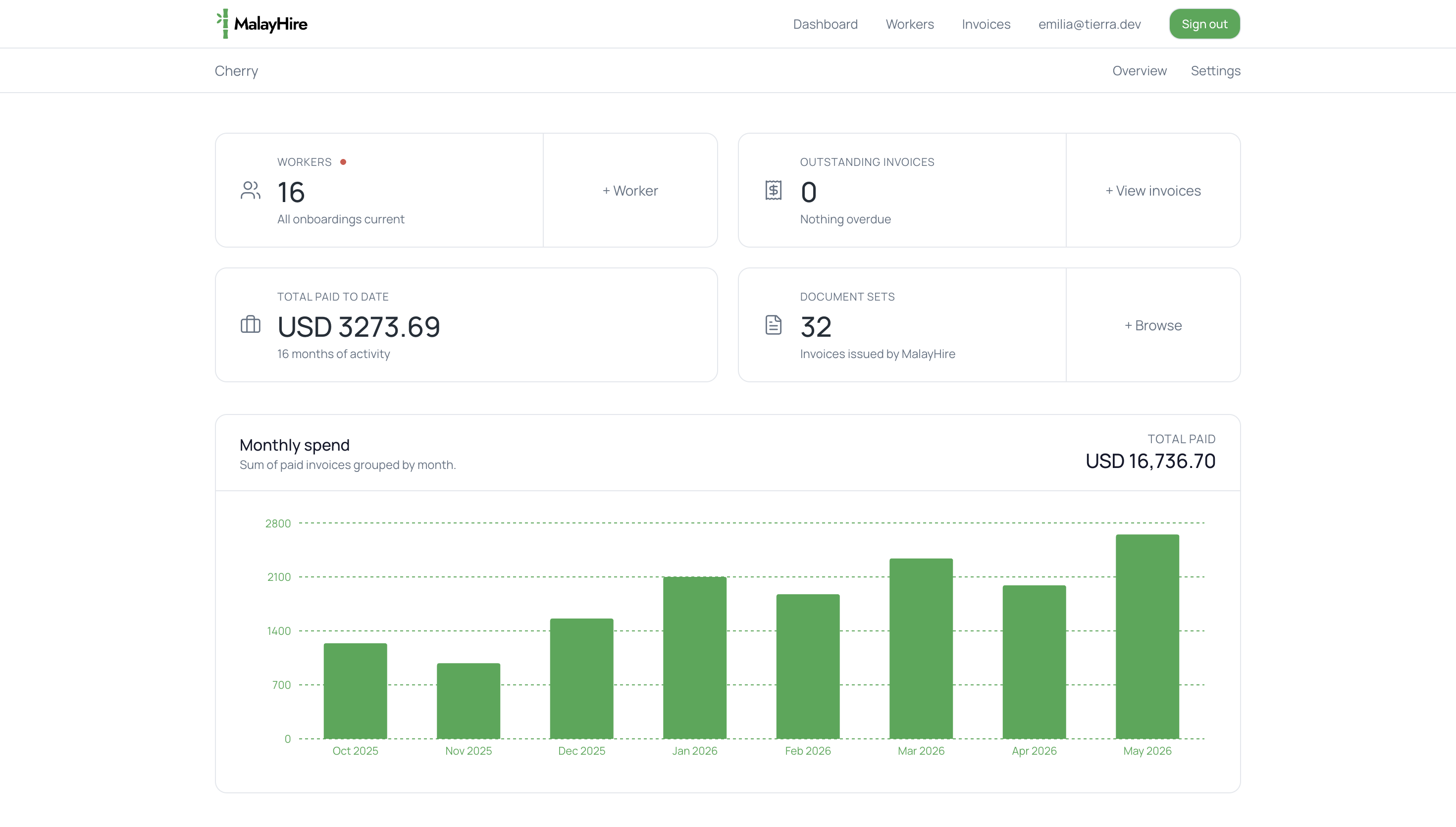
Manage your Malaysian team, payroll & EOR compliance in one place.