
Malaysia Hiring Trends: Validate Compliance and Onboard in 48 Hours with EOR Sandbox Testing


Malaysia Hiring Trends: Validate Compliance and Onboard in 48 Hours with EOR Sandbox Testing

Key Takeaways
- Malaysia hiring trends show an accelerating shift toward ultra-fast, digital-first onboarding for foreign companies, driven by the rising use of Employer of Record (EOR) services.
- EOR sandbox environments let you simulate Malaysia-specific compliance tasks—EPF, SOCSO, PCB, contract clauses, leave entitlements—without touching real payroll or legal contracts.
- The Deel API sandbox, for instance, provides a completely isolated testing environment pre-populated with sample workers, contracts, and organizations, so you can start validating workflows immediately.
- Authenticated API access via token or OAuth2 ensures secure, server-to-server integration, allowing your HR tools to interact with test environments just like they would in production.
- Validating EPF, SOCSO, EIS, and PCB calculations in a sandbox prevents costly compliance errors that can delay hiring and expose your company to penalties.
- Testing contract clauses—probation periods, termination notice, minimum wage, and public holiday handling—ensures your employment agreements meet Malaysian labour law before a single hire is made.
- Foreign worker levy simulations and visa processing logic can be checked in the sandbox, reducing surprises when scaling your team with expatriate talent.
- A well-executed sandbox test run cuts live onboarding time dramatically, putting you on track to hire local employees in as little as 48 hours through a Malaysia-focused EOR.

Why Sandbox Testing Fits Today’s Malaysia Hiring Landscape
When you’re a foreign business eyeing Kuala Lumpur for expansion, the promise of tapping into a skilled workforce within days sounds almost too good to be true. But that’s exactly where Malaysia hiring trends are headed. Companies no longer want to wait weeks for entity setup or drown in paperwork just to bring on a single marketing lead. They’re turning to Employer of Record platforms that promise rapid onboarding—some even in 48 hours—backed by deep local compliance knowledge. But here’s the catch: speed only works if you’re absolutely sure your payroll, taxes, and employment contracts are error-free before that first salary run. That’s where the sandbox becomes your best friend.
The idea of testing in an isolated environment isn’t new for developers, but it’s now gaining serious traction among HR and finance teams pushing into Malaysia. Why? Because the country’s statutory contributions—EPF, SOCSO, EIS, PCB—come with precise rates, varying categories, and regulations that change from time to time. A single misclassification or incorrect proration can mean non-compliance and a bad first impression for your new hire. A proper EOR sandbox lets you rehearse every compliance step with dummy data, so when you go live, you’re not hoping for the best—you’re operating from a verified blueprint. This article walks you through exactly how to leverage sandbox testing to align with current Malaysia hiring trends and achieve that fabled 48-hour onboarding window, without sacrificing a shred of compliance.
What an EOR Sandbox Actually Looks Like
Before diving into the Malaysia-specific workflows, let’s get clear on what an EOR sandbox is and how it differs from the live platform. In the context of global employment platforms, a sandbox is a replica of the production environment, but completely sealed off from real data, real money, and legally binding actions. According to Deel’s developer documentation, their API sandbox is a “completely isolated testing environment that mirrors production functionality without affecting real data, triggering actual payments, or creating legal contracts.” That’s the gold standard. It comes pre-populated with sample contracts, workers, and organizations, so you can begin testing straight away without having to build dummy entities from scratch.
Isolated Testing Without Real Consequences
The beauty of a sandbox is that you can make mistakes—overcalculating EPF, under-withholding PCB, formatting termination clauses incorrectly—and nothing bad happens. There’s no angry employee, no government audit, no reversed bank transfers. You can run your Malaysian payroll scenario a dozen times until it matches the official contribution tables, and only then do you feel confident enough to flip the switch to production.
Pre-populated Data for Immediate Malaysia-Specific Tests
A good EOR sandbox should come loaded with sample data that reflects real-world Malaysian worker profiles. That includes varying salary levels, employment types (permanent, contract, probation), and demographic details like age and citizenship—all of which affect statutory contributions. You don’t waste time creating test users from scratch. Instead, you’re instantly stepping through scenarios like calculating EPF for an employee over 60, or PCB for a non-resident director, ensuring your deployment is battle-tested from day one.
The Rise of Rapid Hiring: Malaysia’s Trends Toward 48-Hour Onboarding
It’s hard to overstate how much the pandemic accelerated digital hiring expectations. In Malaysia, businesses that once tolerated weeks of manual processes now demand fully remote onboarding that can finalize a contract, register the employee with government bodies, and kick off payroll within two working days. This shift isn’t just a preference; it’s becoming a competitive necessity. Startups and SMEs expanding into the country need an “on-the-ground” presence almost instantly, and the EOR model—when combined with robust sandbox pre-validation—makes that possible.
Malaysia hiring trends in 2025 and beyond indicate that rigid, paper-heavy onboarding is fading. Companies are choosing EOR partners that offer fixed monthly pricing and transparent processes, bypassing sales calls and drawn-out implementations. The expectation is clear: sign up, test your flows in a sandbox over a single afternoon, and launch live hiring the next business day. This demand for velocity is exactly why platforms like MalayHire EOR emphasize a 48-hour onboarding guarantee, underpinned by a sandbox environment that lets you confirm every compliance detail ahead of time. It’s not magic—it’s simply smart pre-testing.
- More foreign SMEs are skipping local entity incorporation entirely, using EORs to hire their first Malaysian staff within days.
- Fixed-price EOR services with published rates (e.g., $165/employee/month) allow predictable cost modeling for rapid scaling.
- Integration of EOR platforms with HRIS systems enables frictionless data flow, reducing manual entry and duplication.
- Greater emphasis on transparent compliance validation means more companies are actively requesting sandbox access before committing to a live contract.
- AI-augmented hiring workflows, like those supported by the Deel MCP server for AI agents, hint at a future where intelligent assistants can automate compliance checks within the sandbox.
Getting Started: Setting Up Your Malaysia Compliance Sandbox
To run the tests we’re about to describe, you need working access to an EOR sandbox that has Malaysia-specific configuration. While many global EORs offer generic sandboxes, you’ll want one that supports Malaysian statutory bodies and leave rules out of the box—or at least allows you to configure them. The process typically begins with creating an account, generating API credentials, and then using either API calls or a dashboard to seed your test environment with Malaysian entities.
API Access and Authentication Tokens
If you’re planning to integrate the sandbox into your own HR tech stack, you’ll need to authenticate your requests. Deel, for instance, requires all API calls over HTTPS and supports two authentication methods: a straightforward token-based approach for server-to-server integrations, and OAuth2 for user-authorized apps. For most HR managers testing compliance manually, the token method is the simplest. You’ll navigate to the developer center, generate an access token, and then use it as a bearer token in the authorization header of your API calls. Even if you’re not writing code, many platforms provide a test interface where you can paste the token and immediately start sending sample requests to the sandbox endpoints.
Selecting an EOR Platform with Malaysia-Specific Configurations
Not every global EOR is created equal when it comes to Malaysia. Look for a platform that explicitly supports Malaysian payroll rules, statutory bodies (EPF, SOCSO, EIS), tax calculations (PCB), and leave entitlements in its sample data. Some providers, like MalayHire EOR, are laser-focused on Malaysia and ensure their sandbox reflects local nuances from the get-go—public holiday dates, minimum wage adherence, and probation period norms. Before committing, ask if the sandbox can simulate foreign worker levy calculations and employment pass scenarios if you plan to hire expatriates. The more localised the sample data, the more meaningful your test runs will be.
Step-by-Step: Testing EPF, SOCSO, and PCB Calculations in the Sandbox
This is where the rubber meets the road. Malaysia’s three main statutory contributions form the backbone of your payroll compliance, and getting them wrong is the fastest way to derail your hiring timeline. We’ll walk through each one with a test scenario, using the sandbox to confirm correct amounts before processing a single MYR in the real world. The approach is simple: identify a sample employee record in the sandbox, apply the official contribution tables, run the platform’s calculation, and compare.
EPF Contribution Scenarios
The Employees Provident Fund (EPF) requires both employer and employee contributions at tiered rates. Start by selecting a sample employee under 60 with a monthly wage of RM4,000. The sandbox should automatically deduct 9% from the employee’s salary and add 13% (or 12% depending on legislative phases) from the employer side. Now test an employee over 60 with the same salary—employer contribution drops to 4% and employee share to 0%. Verify that the platform rounds the final figures correctly and that proration works if the employee joined mid-month. If the sandbox calculation deviates from the official EPF table, you’ve caught a configuration error before it becomes a compliance issue.
SOCSO and Employment Insurance System (EIS) Deductions
SOCSO contributions are wage-class based, while EIS follows a separate schedule. Use the sandbox to simulate an employee earning RM3,000 per month. Confirm that employer and employee SOCSO contributions match the published schedule (employer 1.75%, employee 0.5% for Category 1, for example) and that the EIS deductions apply at the statutory rate. Pay special attention to the wage ceiling—contributions drop off above RM4,000. Run a test with a salary of RM5,000 and ensure the SOCSO and EIS amounts are capped correctly. The sandbox should handle these caps automatically, but it’s your job to validate them against the latest Perkeso tables.
PCB Tax Simulations with Sample Employee Data
Potongan Cukai Bulanan (PCB) often trips up even experienced payroll teams. In the sandbox, test a married employee with two children earning RM7,000 monthly, and another single employee with the same income. The net PCB deduction should differ because of the relief categories. Confirm the platform uses the correct tax category based on marital status and dependents. Run a month-end payroll run in the sandbox and review the gross-to-net calculation. Any discrepancy should be flagged immediately—once you go live, correcting PCB errors requires filing amended returns and can lead to employee dissatisfaction.
Validating Employment Contracts and Holiday Leave Entitlements
Compliance isn’t just about numbers. Your employment contract must align with Malaysian labour law, covering probation, termination notice, minimum wage, and public holidays. The fastest way to check this is to generate a sample contract in the sandbox and compare each clause against the Employment Act 1955 and the upcoming Employment (Amendment) Act updates.
Probation Periods and Minimum Wage Clauses
In Malaysia, probation typically spans three to six months, with a notice period within that period ranging from a few days to two weeks, depending on the contract. In your sandbox, pull a sample contract for a new hire. Verify that the probation clause states a clear duration and notice for termination during probation. Check that the salary offered meets or exceeds the current minimum wage of RM1,500 per month. If the platform’s sample contract includes any wages below this, that’s a red flag. Also, confirm that the contract references annual leave entitlements if probation extends past the first year.
Public Holidays and Annual Leave Rules
Malaysia observes a mix of national and state-specific public holidays, and the Employment Act guarantees 11 paid public holidays per year for employees. In the sandbox, look at the platform’s holiday calendar for the current year. Does it include key dates like Hari Raya Aidilfitri, Merdeka Day, and Malaysia Day? Are state holidays accounted for if your employee is based in Penang versus Kuala Lumpur? Test the leave management module: enter a public holiday that falls on a Sunday and confirm the system correctly assigns a replacement holiday on the following Monday. This may seem like a small detail, but failing to provide the correct number of paid public holidays can trigger labour complaints.
Simulating Foreign Worker Levy and Visa Processing in the Sandbox
If your hiring plan includes expatriates, the sandbox becomes even more valuable. Malaysia imposes a foreign worker levy that varies by sector—manufacturing, services, construction—and the rate can change annually. Replicating this in a test environment helps your finance team budget accurately and ensures the EOR platform processes it correctly.
Levy Rates by Sector
In the sandbox, select a sample foreign worker profile and assign it to the services sector. Check that the platform automatically applies the current levy amount, say RM1,850 per year for certain services roles. Switch to manufacturing and confirm the levy changes accordingly. Some EOR sandboxes let you override values, but the baseline should reflect official rates. This is also a good time to simulate levy payments during payroll—does the system deduct it monthly or annually? Knowing this in advance aligns your cash flow expectations.
Visa Status Workflow in the Sandbox
Even if you’re not processing the actual visa application, an EOR can manage the employment pass requirements. In the test environment, walk through the steps of marking an employee’s visa status as “pending,” “approved,” or “rejected.” Check if the system blocks payroll for an employee without a valid work permit. Run a scenario where a visa expires mid-cycle—does the sandbox trigger a notification? These safeguards are critical. When you eventually go live, you’ll have already rehearsed the visa-handling logic, reducing the risk of accidentally employing someone without valid documentation.
Common Pitfalls When Testing Malaysia Payroll Compliance
Even with a fully populated sandbox, teams frequently overlook a few key areas. Being aware of these traps now can save you hours of debugging later.
- Not updating contribution rates: Statutory rates are revised periodically. Always confirm the sandbox reflects the latest EPF, SOCSO, and tax schedules before trusting its calculations.
- Ignoring year-end processing: Run a full 12-month payroll simulation in the sandbox to see how the platform handles EA forms (annual income statement) and CP8D reporting to LHDN.
- Overlooking off-cycle payments: Test bonuses, commissions, and arrears. These influence PCB calculations and EPF contributions differently and may reveal rounding errors.
- Skipping multi-currency tests: If your employee is paid in a currency other than MYR, run a scenario to see how exchange rates affect payroll and statutory deductions.
- Assuming state holidays are universal: Labour law recognizes both national and state-specific holidays. Validate your sandbox calendar for the exact work location of each employee.
From Sandbox to Live: Ensuring a Smooth 48-Hour Onboarding
Once your sandbox tests are complete and you’re satisfied that the platform handles Malaysian compliance correctly, the transition to live hiring should be almost trivial. But there’s a final checklist to guarantee that the 48-hour onboarding promise becomes a reality.
Pre-Transition Checklist
First, export all your validated test scenarios—the sample employee profiles, the calculated contribution amounts, the contract templates—and keep them as reference. Second, confirm that your API tokens or OAuth2 credentials for the live environment are completely separate from the sandbox tokens. You never want test calls accidentally hitting real payroll. Third, do one last sandbox run with the exact profile of the employee you intend to hire, matching their salary, position, and start date. If everything checks out, you’re ready. Providers focused on speed, like MalayHire EOR, often have a dedicated workflow that lets you migrate tested configurations directly into a live contract with a single approval.
When to Involve a Local Payroll Specialist
Sandbox testing can cover 95% of scenarios, but if your hire has highly unusual compensation (stock options, multiple allowances, secondment arrangements), a human expert familiar with Malaysian tax law should review the output. The sandbox is a simulation, not a replacement for legal advice. Use it to build confidence, but don’t hesitate to ask your EOR provider to loop in their in-country team for a final sanity check. The goal is to onboard fast, but never at the expense of compliance.
What Rapid Sandbox-Validated Hiring Means for Your Malaysia Strategy
Treating sandbox testing as a standard step in your Malaysia expansion does more than prevent payroll errors. It fundamentally changes your speed-to-hire calculus. You’re no longer guessing whether your Employer of Record can handle the intricacies of EPF tiering or public holiday proration—you’ve seen it work. That confidence lets you make bolder hiring decisions, scale teams faster, and focus on growing your business instead of firefighting compliance issues.
The trend toward sandbox-first hiring in Malaysia reflects a broader maturity in the EOR space. As more platforms open up their APIs and developers create sandbox environments that are truly reflective of local laws, the barrier to entry for foreign companies drops even further. The possibility of finalizing a fully compliant job offer, employment contract, and payroll registration in two days is no longer a marketing slogan; it’s a repeatable process that you can rehearse and perfect before a single MYR moves. That’s the new normal for Malaysia hiring trends, and it’s a competitive advantage worth embracing.
Frequently Asked Questions
How do you validate EPF and SOCSO calculations in an EOR sandbox for Malaysia?
You validate EPF and SOCSO calculations by inputting employee salary data into the sandbox and comparing automated deductions against Malaysia's statutory contribution rates. The sandbox simulates real-time payroll runs to verify that employer and employee shares match EPF's 11-12% and SOCSO's 0.5-1.75% tiers before transitioning to live onboarding.
What is the typical timeline for onboarding an employee in Malaysia with an EOR?
The typical timeline for onboarding an employee in Malaysia with an EOR can be as short as 48 hours when using sandbox testing to pre-validate compliance. This rapid process involves testing payroll calculations, employment contracts, and statutory contributions in the sandbox environment before finalizing the hire to avoid delays.
Can you test employment contract compliance for Malaysia's holiday leave entitlements in a sandbox?
Yes, you can test employment contract compliance for Malaysia's holiday leave entitlements in a sandbox by inputting contract terms and verifying they meet the Employment Act's minimum of 8 paid public holidays. The sandbox flags discrepancies like insufficient annual leave or incorrect public holiday pay rates before the contract is issued to the employee.
How do you simulate foreign worker levy and visa processing in an EOR sandbox for Malaysia?
You simulate foreign worker levy and visa processing by entering the employee's nationality, job category, and work location into the sandbox to calculate the correct levy amount based on Malaysia's current rates. The sandbox also generates the required visa application timeline to ensure all documentation is ready for submission within the onboarding window.
What are common pitfalls when testing Malaysia payroll compliance in an EOR sandbox?
Common pitfalls when testing Malaysia payroll compliance include inputting incorrect salary base formulas for PCB tax calculations and failing to update statutory rates like EPF or SOCSO thresholds. Another frequent error is omitting overtime or allowances from the payroll simulation, which causes mismatches between sandbox outputs and live payroll runs.
How does sandbox testing support rapid hiring trends in Malaysia's 48-hour onboarding focus?
Sandbox testing supports rapid hiring trends by allowing employers to pre-validate all compliance requirements—including payroll, contracts, and statutory filings—before the employee starts. This eliminates back-and-forth corrections during the onboarding process, enabling the EOR to finalize employment within 48 hours while staying fully compliant with Malaysia's labor laws.
What steps are involved in setting up a Malaysia compliance sandbox for EOR testing?
Setting up a Malaysia compliance sandbox involves creating a controlled environment with dummy employee profiles, configuring statutory deduction tables for EPF and SOCSO, and integrating a payroll engine with PCB tax rules. You then run test scenarios for salary calculations, overtime, and leave entitlements to ensure all outputs match official requirements before moving to live operations.
MalayHire is your most cost-effective Employer of Record (EOR) in Malaysia
Hire full-time employees in Malaysia and save costs by avoiding hefty contractor fees. MalayHire handles payroll, employment contracts, statutory compliance (EPF, SOCSO, EIS), and HR admin. Start onboarding your Malaysian hire now, with MalayHire.
Trusted by global companies hiring in Malaysia





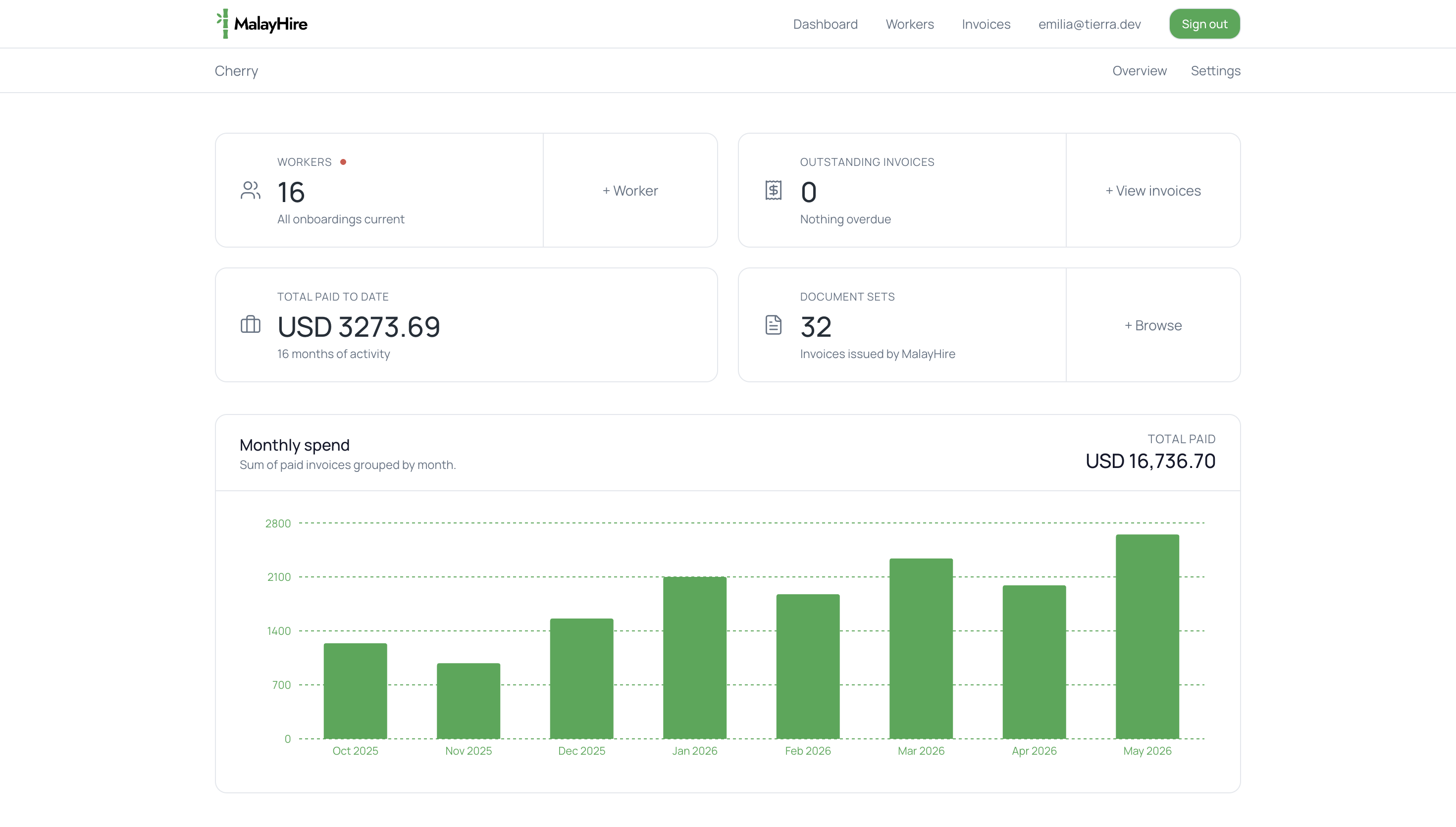
Manage your Malaysian team, payroll & EOR compliance in one place.