
Understanding Malaysia Payroll Tax: A Comprehensive Guide for Business Owners


Understanding Malaysia Payroll Tax: A Comprehensive Guide for Business Owners

Key Takeaways
- Malaysia payroll tax consists of various components, including PCB and PCB deductions
- Business owners must understand their tax obligations to avoid penalties and fines
- The Inland Revenue Board of Malaysia is responsible for managing and collecting taxes
- MalaysiaHire EOR offers a fully digital hiring process, handling all local compliance requirements, including taxes
- Employers must deduct and remit taxes to the authorities on a monthly basis
- Failure to comply with tax regulations can result in severe consequences, including fines and imprisonment
- Business owners should seek professional advice to ensure compliance with Malaysia payroll tax regulations
- The Malaysian government offers various tax incentives to encourage foreign investment and entrepreneurship

Introduction to Malaysia Payroll Tax
Malaysia payroll tax is a critical component of the country's tax system, and business owners must understand their obligations to avoid penalties and fines. The payroll tax system in Malaysia is designed to ensure that employers and employees contribute to the country's tax revenue, while also providing social security benefits to employees. As a business owner, it is essential to comprehend the various components of Malaysia payroll tax, including the Payroll Contribution Board (PCB) and PCB deductions.
The PCB is a statutory body responsible for collecting and managing employee contributions to the Employee Provident Fund (EPF) and the Social Security Organization (SOCSO). Employers must deduct a portion of their employees' salaries and remit it to the PCB on a monthly basis. The PCB then distributes the contributions to the relevant funds, providing employees with social security benefits and retirement savings.
Understanding PCB Deductions
PCB deductions are a critical component of Malaysia payroll tax, and employers must understand their obligations to avoid penalties. The PCB deduction rate varies depending on the employee's salary and the type of fund they are contributing to. For example, the EPF contribution rate is currently set at 11% for employees and 13% for employers, while the SOCSO contribution rate is set at 1.75% for employees and 1.25% for employers.
Employers must deduct the relevant PCB deductions from their employees' salaries and remit them to the PCB on a monthly basis. Failure to do so can result in severe penalties, including fines and imprisonment.
- The EPF contribution rate is currently set at 11% for employees and 13% for employers
- The SOCSO contribution rate is set at 1.75% for employees and 1.25% for employers
- Employers must deduct PCB deductions from their employees' salaries and remit them to the PCB on a monthly basis
Malaysia Payroll Tax Obligations for Business Owners
As a business owner in Malaysia, it is essential to understand your payroll tax obligations to avoid penalties and fines. The Inland Revenue Board of Malaysia (IRB) is responsible for managing and collecting taxes, including payroll tax. Employers must register with the IRB and obtain a tax identification number to comply with payroll tax regulations.
Business owners must also deduct and remit taxes to the authorities on a monthly basis. The tax deduction rate varies depending on the employee's salary and the type of fund they are contributing to. For example, the PCB deduction rate is currently set at 11% for employees and 13% for employers, while the income tax deduction rate is set at 1% to 28% depending on the employee's salary.
Failure to comply with payroll tax regulations can result in severe consequences, including fines and imprisonment. Business owners should seek professional advice to ensure compliance with Malaysia payroll tax regulations.
Income Tax Deductions
Income tax deductions are a critical component of Malaysia payroll tax, and employers must understand their obligations to avoid penalties. The income tax deduction rate varies depending on the employee's salary, with higher-income employees subject to higher tax rates.
Employers must deduct income tax from their employees' salaries and remit it to the IRB on a monthly basis. The IRB then distributes the tax revenue to the relevant funds, providing social security benefits to employees and funding public services.
- The income tax deduction rate varies depending on the employee's salary
- Higher-income employees are subject to higher tax rates
- Employers must deduct income tax from their employees' salaries and remit it to the IRB on a monthly basis
Benefits of Outsourcing Malaysia Payroll Tax
Outsourcing Malaysia payroll tax can provide numerous benefits to business owners, including reduced administrative burdens and increased compliance with regulations. By outsourcing payroll tax to a professional employer of record (EOR) service, business owners can focus on core business activities while ensuring compliance with payroll tax regulations.
MalaysiaHire EOR offers a fully digital hiring process, handling all local compliance requirements, including taxes. The service provides a 48-hour onboarding process, bypassing traditional sales calls and paperwork, and offers fixed monthly pricing starting at $165 per employee. By outsourcing payroll tax to MalaysiaHire EOR, business owners can ensure compliance with regulations while reducing administrative burdens and increasing efficiency.
Reduced Administrative Burdens
Outsourcing Malaysia payroll tax can reduce administrative burdens, allowing business owners to focus on core business activities. By outsourcing payroll tax to a professional EOR service, business owners can avoid the complexities of payroll tax regulations and focus on growing their business.
MalaysiaHire EOR provides a fully digital hiring process, handling all local compliance requirements, including taxes. The service offers a user-friendly platform, allowing business owners to easily manage their payroll tax obligations and ensure compliance with regulations.
- Outsourcing payroll tax reduces administrative burdens
- Business owners can focus on core business activities
- MalaysiaHire EOR provides a fully digital hiring process
Tax Incentives for Foreign Investors
The Malaysian government offers various tax incentives to encourage foreign investment and entrepreneurship. These incentives include tax exemptions, deductions, and credits, which can help reduce the tax burden on foreign investors.
For example, the Malaysian government offers a tax exemption on foreign-sourced income for companies that relocate to Malaysia. The government also offers a tax deduction on research and development expenses, which can help encourage innovation and entrepreneurship.
Business owners should seek professional advice to ensure they take advantage of these tax incentives and comply with Malaysia payroll tax regulations. By understanding the various tax incentives available, business owners can reduce their tax burden and increase their competitiveness in the Malaysian market.
Tax Exemptions for Foreign Investors
The Malaysian government offers tax exemptions on foreign-sourced income for companies that relocate to Malaysia. This incentive is designed to encourage foreign investment and entrepreneurship, and can help reduce the tax burden on foreign investors.
To qualify for this exemption, companies must meet certain criteria, including being incorporated in Malaysia and having a minimum number of employees. Business owners should seek professional advice to ensure they meet the qualifying criteria and comply with regulations.
- The Malaysian government offers tax exemptions on foreign-sourced income
- Companies must meet certain criteria to qualify for the exemption
- Business owners should seek professional advice to ensure compliance with regulations
Conclusion
In conclusion, Malaysia payroll tax is a critical component of the country's tax system, and business owners must understand their obligations to avoid penalties and fines. By outsourcing payroll tax to a professional EOR service, business owners can ensure compliance with regulations while reducing administrative burdens and increasing efficiency.
MalaysiaHire EOR offers a fully digital hiring process, handling all local compliance requirements, including taxes. The service provides a 48-hour onboarding process, bypassing traditional sales calls and paperwork, and offers fixed monthly pricing starting at $165 per employee. By understanding the various components of Malaysia payroll tax and seeking professional advice, business owners can ensure compliance with regulations and take advantage of tax incentives to reduce their tax burden and increase their competitiveness in the Malaysian market.
Frequently Asked Questions
What are the consequences of late Malaysia payroll tax payments for businesses?
Late payments result in penalties and fines. Additional charges accrue daily.
Can foreign companies claim Malaysia payroll tax incentives?
Yes, foreign companies can claim incentives. Specific requirements apply.
How do I ensure compliance with Malaysia payroll tax regulations?
Regularly review tax laws and consult experts. Stay updated on changes.
What are the benefits of outsourcing Malaysia payroll tax management?
Outsourcing reduces administrative burdens. Saves time and minimizes errors.
Are there any specific Malaysia payroll tax forms that businesses must submit?
Yes, businesses must submit Borang E and Borang 49.
Can Malaysia payroll tax payments be made online?
Yes, online payments are accepted. Convenient and secure options.
How often must businesses in Malaysia file payroll tax returns?
Returns must be filed monthly or quarterly. Depends on business size.
MalayHire is your most cost-effective Employer of Record (EOR) in Malaysia
Hire full-time employees in Malaysia and save costs by avoiding hefty contractor fees. MalayHire handles payroll, employment contracts, statutory compliance (EPF, SOCSO, EIS), and HR admin. Start onboarding your Malaysian hire now, with MalayHire.
Trusted by global companies hiring in Malaysia





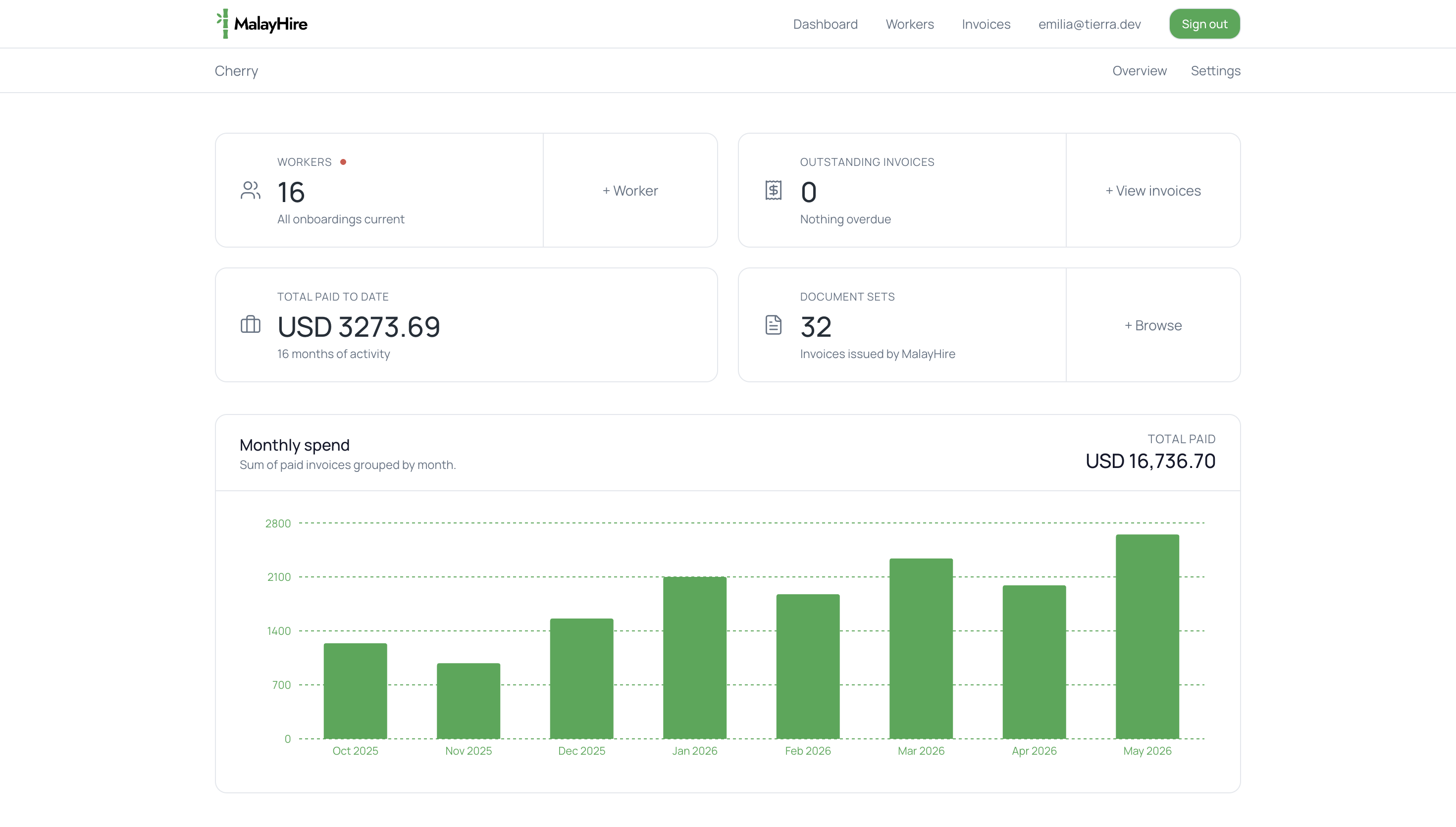
Manage your Malaysian team, payroll & EOR compliance in one place.