
Why Invest in Malaysia: A Compliance-First Guide to Rapid Market Entry


Why Invest in Malaysia: A Compliance-First Guide to Rapid Market Entry

Key Takeaways
- Malaysia's strategic position in Southeast Asia, combined with a skilled, multilingual workforce and pro-business policies, makes it a prime destination for foreign investment.
- The compliance landscape—including mandatory EPF, SOCSO, and PCB contributions—can be a major hurdle for foreign companies without a local entity.
- Employer of Record services eliminate the need to navigate complex registrations, allowing businesses to hire and pay compliantly within days.
- Platforms like MalayHire EOR offer 48-hour onboarding, transforming what used to take months of paperwork into a digital, fixed-price process starting at $165/month.
- Sandbox testing environments from global EORs provide useful API data but often fall short on real-world Malaysian regulatory nuances, making local expertise invaluable.
- Common compliance pitfalls, such as misclassifying employees or missing statutory filing deadlines, can lead to penalties—which a specialized EOR is designed to prevent.
- Malaysia's growing digital economy, government incentives, and vibrant expat-friendly culture further strengthen the case for investing now.
- By leveraging a local EOR, companies can test the Malaysian market with minimal risk before committing to a full-fledged subsidiary.

The Malaysia Investment Landscape at a Glance
If you're asking why invest in Malaysia, the conversation usually starts with geography. Sitting at the heart of ASEAN, Malaysia offers a springboard into a market of over 650 million people. But there's a lot more beneath the surface. The country has quietly built a business environment that blends first-world infrastructure with operating costs that are still remarkably sane. Kuala Lumpur's skyline mirrors the ambition—tech hubs, financial districts, and a growing list of Fortune 500 regional headquarters. The workforce is young, largely English-speaking, and increasingly digital-savvy. Government bodies like MIDA and MDEC roll out red carpets for foreign investors through tax incentives, grants, and special economic zones.
Yet for all the buzz about opportunity, there's a less glamorous side that can stall momentum fast: compliance. Malaysia takes its labor laws seriously. EPF, SOCSO, EIS, PCB—these aren't just acronyms to ignore. For a foreign company without a local legal entity, getting them right can feel like deciphering a new alphabet. The good news? The way companies enter the market has changed. Modern Employer of Record solutions strip away the complexity, turning a months-long setup into a matter of days. This article isn't a rehash of why Malaysia is great on paper. Instead, we're going deep into the compliance engine that actually makes investing here practical—and how the right EOR can be the difference between a stalled expansion and a team on the ground by next week.
The Compliance Reality: What Foreign Employers Must Navigate
Before you can even think about business strategy, you need to square up with Malaysia's mandatory statutory framework. Every employer—local or foreign—has obligations the moment an employee signs a contract. There's no grace period while you figure things out. The system is built to protect workers, and it's enforced rigorously. Miss a filing or miscategorize a contribution, and you're looking at fines, interest, and potentially a visit from the authorities.
For a company testing the waters, the compliance checklist can be intimidating. The good news is that with the right support, these are boxes to tick, not walls to climb. Let's break down the big-ticket items that trip up most first-time entrants.
Registering for EPF and SOCSO: The First Hurdle
The Employees Provident Fund (EPF) and Social Security Organization (SOCSO) are the backbone of Malaysia's social safety net. For any employee earning a salary, you’re required to register with both bodies, contribute a percentage of the employee's wage, and remit payments monthly. EPF contributions are shared between employer and employee; SOCSO is largely employer-borne. The registration process involves submitting forms like KWSP 1 and Borang 2 to the respective agencies, often requiring a local address and a company representative with a physical presence. Foreign companies without a registered office historically needed to set up a branch or appoint a local director—a process that can take 8 to 12 weeks. An EOR already has these registrations in place, absorbing the paperwork completely.
Monthly PCB Tax Deductions: Staying Ahead of Liabilities
Potongan Cukai Bulanan (PCB), or Monthly Tax Deduction, is the mechanism for withholding income tax from employees' salaries. Employers must calculate the correct deduction based on the employee's chargeable income, using LHDN's tax tables, and remit it by the 15th of the following month. Errors in PCB calculations—especially for foreign employees with different residency status—can result in underpaid taxes and employer liability. The penalty interest on late payments starts at 10%, and repeated non-compliance can trigger audits. Again, this is where a local EOR’s payroll engine, pre-configured with the latest PCB schedules, becomes a silent guardian. You never have to second-guess whether a new tax relief or updated threshold has been applied.
Employment Insurance System and HRDF: The Overlooked Obligations
Beyond EPF and SOCSO, there’s the Employment Insurance System (EIS), which provides income support for retrenched workers, and the Human Resources Development Fund (HRDF) levy for certain industry sectors. Both are mandatory where applicable. EIS requires a tiny contribution from both parties; HRDF is a 1% levy on the employer's monthly payroll for firms with 10 or more Malaysian employees in specified sectors. Missing these isn't just a compliance gap—it can also make your company ineligible for government training grants and damage your reputation as a responsible employer. Specialized EOR platforms track these niche requirements by default, ensuring your onboarding checklist doesn't have a surprise at the end.
Why EOR Solutions Are Reshaping Malaysia's Investment Appeal
The traditional route to employing someone in Malaysia—setting up a Sendirian Berhad (private limited company)—is slow and capital-intensive. You're looking at a minimum of RM 500,000 paid-up capital for full foreign ownership in many sectors, plus ongoing secretarial, audit, and operational costs. That model made sense when companies were committing to five-year plans. It doesn't make sense when you need a sales director on the ground in Kuala Lumpur next month.
This is where the Employer of Record model fundamentally alters the equation. An EOR legally employs your team on your behalf, taking on all statutory employer responsibilities. You direct the day-to-day work; the EOR handles contracts, payroll, taxes, and contributions. The result? The question 'why invest in Malaysia?' gets a very different answer when you can be fully operational in under a week without establishing a legal entity.
Speed Without Sacrificing Control
A specialized local EOR like MalayHire isn't a middleman that dilutes your relationship with your team. You retain full management control over hiring decisions, work assignments, and performance. What you hand over is the administrative burden. Contracts are localized to comply with the Employment Act 1955, probation periods are legally watertight, and termination procedures follow Malaysian industrial relations practice. This speed-to-market advantage is a direct answer to why invest in Malaysia right now: you can land and expand before competitors even open a bank account.
The Fixed-Price Transparency Advantage
Cost uncertainty is a deal-breaker for many businesses considering a new market. Global EOR platforms often operate on complicated per-employee fee structures that can balloon with currency adjustments or add-on services. A local provider like MalayHire EOR offers fixed monthly pricing—starting at $165 per employee—covering all core compliance work. There are no hidden fees for EPF registration, SOCSO filings, or tax remittance. That predictability lets you budget accurately and answer the question 'can we afford to invest in Malaysia?' with a simple yes.
Inside a 48-Hour Onboarding Sprint: From Zero to Fully Compliant
The claim of 48-hour onboarding might sound like marketing fluff, but when you strip away the entity setup bottleneck, the remaining steps are logical and sequential. A focused EOR platform digitizes the entire workflow, making what used to be a paper-chase into a gated checklist. Here's how a specialized provider gets your first employee on the ground—compliantly—in two business days.
Hour 1–8: Employee Identification and Document Collection
The process kicks off with the candidate uploading essential KYC documents: a copy of their MyKad (for Malaysians) or passport and work permit (for expats), EPF and SOCSO numbers if previously employed, and tax file number. The EOR’s platform verifies these against official databases in real-time. Simultaneously, you provide basic employment details—start date, monthly salary, any allowances—through a secure dashboard. No phone calls, no PDF forms to email back and forth.
Hour 8–24: Contract Generation and Compliance Validation
The system auto-generates an employment contract that conforms to the Malaysian Employment Act. It includes all statutory clauses: working hours, annual leave, sick leave, public holidays, and termination notice periods. The contract is digitally signed by both parties. Behind the scenes, the platform runs a compliance check against minimum wage thresholds, SOCSO wage bands, and PCB category to ensure the salary package doesn't trigger any classification errors. This is where a local EOR’s deep regulatory knowledge is worth more than a generic template.
Hour 24–36: Statutory Registration and Payroll Setup
If the employee isn't already registered with EPF and SOCSO, the EOR initiates the registration immediately—often using pre-established government portals that accept digital submissions. The payroll engine is configured with the employee’s fixed and variable components, mapped to the correct statutory codes. A test payroll run verifies that gross-to-net calculations match expectations and that employer contributions are accurately accrued. The EOR also ensures the company is set up for PCB remittance and issues a pay-slip template for the first cycle.
Hour 36–48: Final Verification and Go-Live
By the final stage, all registrations are confirmed, the payroll schedule is locked, and the employee receives a welcome kit covering their rights, benefits, and the EOR support contact. The client gets a compliance summary report—proof that EPF, SOCSO, EIS, and PCB are all activated. The employee is now ready to start work immediately, with the first payroll processed on the upcoming cycle. That’s the operational reality behind the 'why invest in Malaysia' narrative: execution that matches the ambition.
Sandbox vs. Reality: Why Testing Isn't Enough
Global EOR platforms have brought welcome innovation by offering API sandboxes that let companies simulate hiring and payroll processes before going live. According to Deel's API documentation, their sandbox is a completely isolated testing environment pre-populated with sample data, allowing full API access without real money, contracts, or legal implications. This is genuinely useful for companies that need to integrate their own HRIS or test payroll calculations in a controlled space. But when you're dealing with a market as specific as Malaysia, sandbox sample data can create a dangerous illusion of readiness.
What the Deel Sandbox Gets Right
The Deel sandbox reflects the platform's production endpoints accurately. You can run through employee creation, contract generation, and payment scheduling, observing the API responses and error codes as they would appear in a live environment. The authentication methods—API Tokens for server-to-server calls and OAuth 2.0 for user-authorized access—are fully functional. This makes it an excellent tool for validating the mechanics of integration, testing authentication flows, and training developers on the API contract.
Where Global Sandboxes Miss Malaysia-Specific Marks
The problem is the sample data itself. Deel's sandbox datasets are designed to be generic enough for hundreds of countries. Malaysia's EPF contribution rates, for instance, differ based on whether the employee is a Malaysian citizen, a permanent resident, or a foreign worker. SOCSO has multiple wage bands and contribution classes that change with government circulars. The PCB tables get updated annually in the federal budget. A sandbox might use a default set of tax rates, but it cannot guarantee they match the latest LHDN gazette. Without continuously updated local data, your sandbox testing might pass all checks but still produce inaccurate contributions in production.
The Local Knowledge Advantage
This is precisely why a Malaysia-specialist EOR provides a different kind of confidence. Instead of requiring you to test compliance in a sandbox and then validate it against real regulatory data, the compliance logic is already live and battle-tested. MalayHire EOR's platform is built on actual Malaysian wage thresholds, current EPF and SOCSO tables, and real tax deduction formulas. There's no gap between 'sandbox success' and 'first payroll run'—you step directly into a compliant ecosystem. That localized certainty is a quieter but equally important part of why invest in malaysia makes sense: you don't have to become a compliance expert to get it right.
The Talent and Lifestyle Equation: Another Piece of the Investment Puzzle
Any conversation about why invest in Malaysia eventually lands on the people. The country's working culture is a unique blend of Asian work ethic and multicultural flexibility. Offices in Kuala Lumpur switch effortlessly between English, Mandarin, Bahasa Malaysia, and Tamil. Collaboration is direct but respectful, decision-making tends to be consensus-driven, and the general approach to business relationships is long-term. For foreign managers, this translates into an environment where talent is accessible, adaptable, and surprisingly easy to integrate into global teams.
Life in Malaysia for expats adds another layer of attraction. The cost of living in Kuala Lumpur is roughly 30-50% lower than in Singapore or Hong Kong, yet the lifestyle—modern condos, international schools, world-class healthcare—is on par. The food scene alone is a retention tool. Digital nomads and senior hires alike are drawn by Malaysia's strategic time zone, decent infrastructure, and a government that's actively courting foreign professionals through programs like the Malaysia Digital Economy Corporation's (MDEC) expatriate services. These soft factors aren't just nice-to-haves; they directly impact your ability to recruit and keep the people who will make your market entry successful. When the question 'why invest in malaysia?' comes up in a boardroom, the talent and lifestyle answer might just tip the scales.
Making the Strategic Move
The narrative around why invest in Malaysia has shifted. It's no longer a story about cheap manufacturing or a gateway that requires a massive, risky commitment. The country has matured into a high-value digital economy with a regulatory framework that is strict but entirely navigable—if you have the right local partner. The old barriers of entity registration, statutory filings, and tax withholding can all be absorbed by an Employer of Record that knows the terrain better than any API sandbox.
The playbook is clear: pick a specialized EOR, onboard your first employee within 48 hours, and let the platform's compliance engine do the heavy lifting while you focus on building your business. The cost of entry is lower, the timeline is shorter, and the margin for error shrinks dramatically when local expertise is baked into the service. If you've been waiting for the right moment to answer the 'why invest in Malaysia' question with concrete action, that moment is now—and it starts with a single compliant hire.
Frequently Asked Questions
How quickly can a foreign company set up a legal entity in Malaysia?
A foreign company typically needs two to three months to register a local subsidiary in Malaysia. This timeline depends on obtaining approvals from the Companies Commission of Malaysia and the Malaysian Investment Development Authority. Using an Employer of Record provider can bypass entity setup and enable hiring within 48 hours.
What are the key compliance risks foreign employers face when entering Malaysia?
Foreign employers must comply with the Employment Act 1955, the Industrial Relations Act, and mandatory EPF, SOCSO, and EIS contributions. Non-compliance with statutory deductions or employee termination procedures can result in fines, penalties, or legal disputes. Engaging a local compliance expert or an EOR partner mitigates these risks significantly.
Can an Employer of Record handle work permits and visa processing for foreign hires in Malaysia?
Yes, an Employer of Record manages the full work permit application process for expatriates, including Employment Pass and Professional Visit Pass applications. They coordinate with Expatriate Committees and immigration authorities to ensure timely approval. This service is critical for rapid market entry without establishing a legal entity first.
Is it cheaper to use an EOR or incorporate a company when entering Malaysia?
Using an Employer of Record is typically cheaper for companies testing the market or hiring fewer than ten employees initially. Incorporation costs range from RM 20,000 to RM 50,000, plus ongoing accounting and legal fees, while EOR services charge a monthly per-employee fee. For long-term operations with a large team, incorporation becomes more cost-effective.
What is the minimum salary requirement for an Employment Pass in Malaysia?
The minimum monthly salary requirement for an Employment Pass in Malaysia is RM 5,000 for Category III, RM 10,000 for Category II, and RM 20,000 for Category I. These thresholds are set by the Expatriate Committee and are subject to periodic review by the Malaysian government. Employers must verify current rates before applying.
How does Malaysia's tax system affect foreign investors and their expatriate employees?
Malaysia imposes a corporate tax rate of 24% and a progressive personal income tax rate for expatriates of up to 30%. Foreign employees working over 60 days in Malaysia are generally taxable, though double taxation agreements may apply. Investors should structure employment contracts to include tax equalization or indemnity clauses for compliance.
What are the labor law differences between hiring local and foreign employees in Malaysia?
Malaysia's Employment Act 1955 applies to all employees earning under RM 2,000 per month, but foreign employees earning above this threshold have fewer statutory protections like overtime. Foreign employees are ineligible for Malaysian social security schemes such as SOCSO but may require private medical insurance. Contract terms must specify termination notice periods and non-compete clauses.
Can a foreign company legally employ remote workers in Malaysia without a local entity?
Yes, a foreign company can legally employ remote workers in Malaysia through an Employer of Record provider that acts as the legal employer. The EOR handles payroll, tax compliance, and statutory contributions under Malaysia's labor laws. This arrangement is fully compliant and avoids the requirement for a registered foreign branch or subsidiary.
MalayHire is your most cost-effective Employer of Record (EOR) in Malaysia
Hire full-time employees in Malaysia and save costs by avoiding hefty contractor fees. MalayHire handles payroll, employment contracts, statutory compliance (EPF, SOCSO, EIS), and HR admin. Start onboarding your Malaysian hire now, with MalayHire.
Trusted by global companies hiring in Malaysia





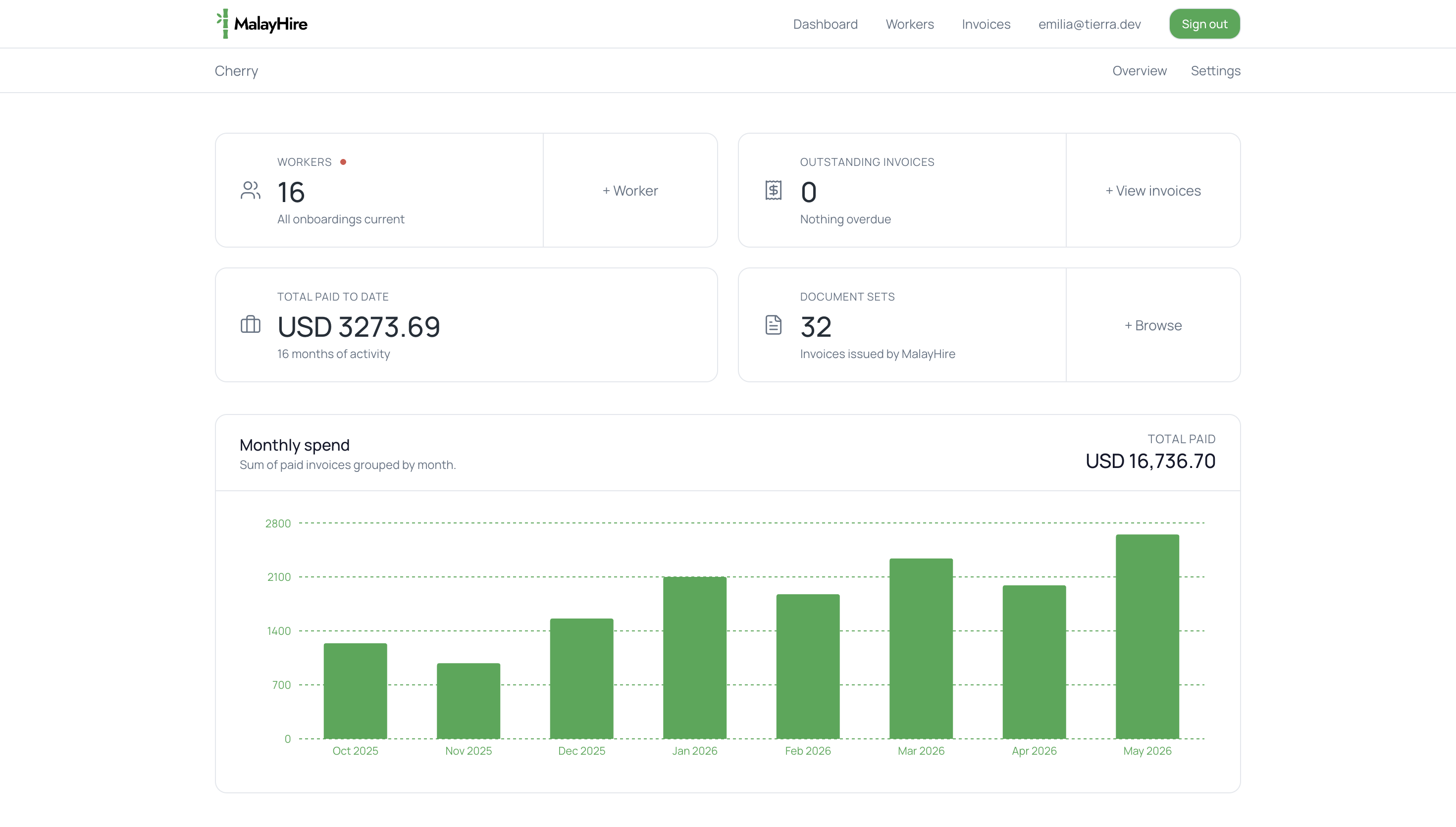
Manage your Malaysian team, payroll & EOR compliance in one place.